


The Huckleberries Vol. 10 - How to Make a Killing & GOAT
Obviously we want to have an area for reviewing new films here at The Film Encomium, but we want to send a message with our methodology. That message is a simple one: Don’t forget about the fun.
Yes, film can be transformative, prophetic, and groundbreaking. It can also be none of those things and still be a damn good time, and we want to validate both of those experiences. If you are looking for classic cinema that slipped under the radar we recommend Robert Hamer—but if you want to become well-rounded, you’ll have to learn how to smile at a list of all the characters Billy West ever gave voice to.
It is from the balance of Tom Sawyer and Huck Finn that we draw inspiration for the title of this section. Tom is clever; Tom is great. If there were one of those boys we were going to try to get into Harvard, it would be young Mr. Sawyer…but he will always need his Huckleberry.
We all need our Huckleberries. Art needs its Huckleberries. Sometimes beauty is in the little things and reasoned reflection. Other times beauty is loud, bright, and bold. In the interest of providing our readers with a comprehensive experience, we are not willing to skip The Huckleberries.
So, with that in mind, here are two engrossing flicks that dropped in theaters recently. The first will find magic in rethinking what it means to be great. The second will dazzle you with dreams of hitting the big time. Enjoy!
How to Make a Killing -

The world needs to get ready for John Patton Ford, for he has put us on notice. His first feature film, Emily the Criminal, was a darling with both critics and former presidents alike. His second attempt? It seems to be sailing over the heads of the critics, with former presidents still yet to publicly weigh in on the situation, at least as of the time of this review.
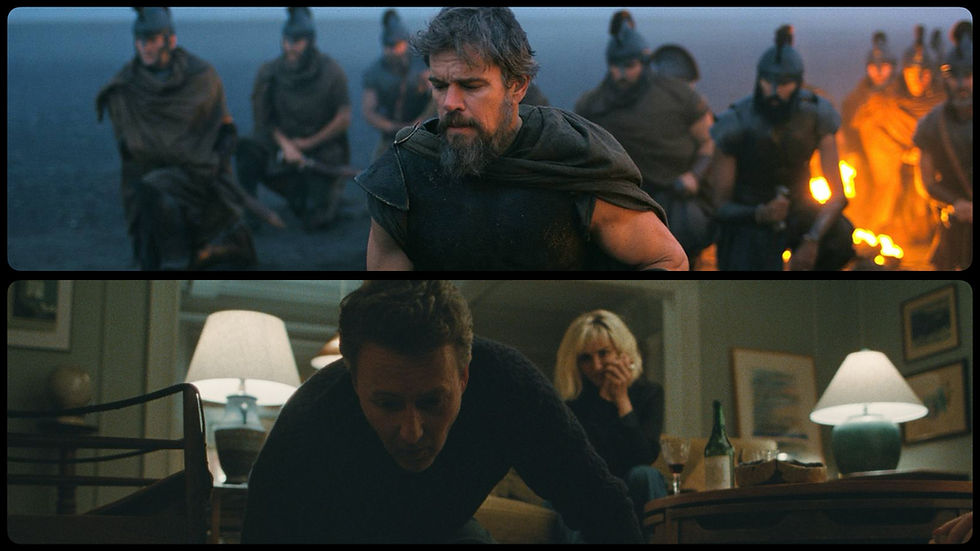
First and foremost, we need to address what so much of the viewing public seems to be missing about this movie. You will not be able to fully appreciate it for what it is if you do not have at least a passing familiarity with Robert Hamer’s 1949 classic Kind Hearts and Coronets. How to Make a Killing is a loose adaptation of that work, and “loose” can carry a wide variety of meanings in such a scenario.
You see, when one sets out to make a direct adaption of something they are essentially just trying to copy it, but a loose adaptation can be a creative reimagining, a spiritual successor, a near-direct adaptation that takes one or two massive creative liberties, or any and everything between those marks. In the case of these two films, it is more like watching two dance partners, with Kind Hearts and Coronets taking the lead. When you observe Ford’s adaptation through this lens it becomes much easier to see it for the ambitious and intelligent attempt that it is.
There are complaints out there about the odd pacing of How to Make a Killing, or perhaps about how Margaret Qualley’s portrayal of Julia comes off as vapid and absurd. Such gripes may be valid if viewing the content within a vacuum, but when you take into account that it is merely trying to move in step with a flick that predates McCarthyism, suddenly a great deal of artistic choices start to look more calculated.
Nowhere is the commitment to this dance more evident than in the performances from Qualley, Jessica Henwick, and the star of the show Glen Powell. These are three lost souls transplanted from the late-40s to modern day, and dropped into a half-blind love triangle that they dragged through time with them. Powell in particular manages to serve as not only a reflection of contemporary society, but also a shadow of the culture we have grown forth from.
When the curtain goes down, How to Make a Killing manages to have tiptoed through two realities itself. There is the face value assessment, where it succeeded in creating a sexy black comedy that is a perfectly acceptable way to work your way through a bucket of popcorn. Which is really quite outstanding, considering the true beauty it produces lies in the love letter to timeless cinema it leaves between the lines.
GOAT -

So, this is a movie made for basketball fans, particularly kids. Do you like basketball? If not, do you have a kid who enjoys basketball? If you answered yes to the first, continue reading; if you answered yes to the second, hand whatever device you are reading this on to your child and point to the next paragraph down.
Okay, now that they are gone, we can speak amongst ballers. Y’all know how there was this whole generation that everyone including LeBron James was very confident was just supposed to be “LeBron’s Generation” until a trash-talking little guard who didn’t even bother to be from a different town than Akron came through and dropped bombs all over those plans? Because I’m fairly certain that Lebron hasn’t been able to forget about Steph Curry, and this flick is another big W for Team Chef.
That’s because what this film represents as much as anything else is a far superior spiritual successor to the magic of Space Jam than anything Space Jam: A New Legacy brought to the table. This is the hardcourt classic that a fresh crop of youths will grow up with. Steph doesn’t force his face front-and-center, but the final product still has his fingerprints all over it.
The entire concept is about an undersized shooter who has to figure out how to make it in a league of comparative physical monsters. They handed the animation reins over to Sony Imageworks—the same absolute geniuses whose work since the first Spider-Verse movie has already led to a new era in creative illustration. GOAT is another great example of the sort of mind-bending art at Imageworks that has redirected the course of mainstream animation, and as usual, it is an absolute delight to behold.
For the next ingredient in this hoop soup, they assembled a stellar squad of voice actors headlined by Caleb McLaughlin and Gabrielle Union. The list of real-world pros with cameos in GOAT includes: Dwayne Wade, A’ja Wilson, Andre Iguodala, Angel Reese, and Kevin Love. Combined with a supporting role for Steph (and Ayesha), this helps to contribute to the story’s overall grasp on the heart of the game.
Say hello to another incredible success story for Imageworks, Curry, and sports cinema as a whole. It is certainly made for younger audiences, but there is plenty here for adults to love as well. Charming characters, an aesthetic that pops off of the screen, and a well-written arc all help this come together into an instant classic in its specific subgenre—and those results are showing up at the box office. Ball don’t lie.
~The Film Encomium~


Comments