


The Huckleberries Vol. 4 - Dead Man’s Wire & All You Need Is Kill
- Jan 20
- 4 min read
Obviously we want to have an area for reviewing new films here at The Film Encomium, but we want to send a message with our methodology. That message is a simple one: Don’t forget about the fun.
Yes, film can be transformative, prophetic, and groundbreaking. It can also be none of those things and still be a damn good time, and we want to validate both of those experiences. If your goal is the study of revolutionary collaboration in works of anti-authoritarianism, we recommend the films of Sidney Lumet—but if you want to become well-rounded, we still recommend mixing in some family-friendly comic bonding, courtesy of Chris Columbus.
It is from the balance of Tom Sawyer and Huck Finn that we draw inspiration for the title of this section. Tom is clever; Tom is great. If there were one of those boys we were going to try to get into Harvard, it would be young Mr. Sawyer…but he will always need his Huckleberry.
We all need our Huckleberries. Art needs its Huckleberries. Sometimes beauty is in the little things and reasoned reflection. Other times beauty is loud, bright, and bold. In the interest of providing our readers with a comprehensive experience, we are not willing to skip The Huckleberries.
So, with that in mind, here are two engrossing flicks that dropped in theaters recently. The first will transport you into the existence of the dismissed and downtrodden. The second will bring in a more animated ordeal to break up the daily monotony. Enjoy!
Dead Man’s Wire -
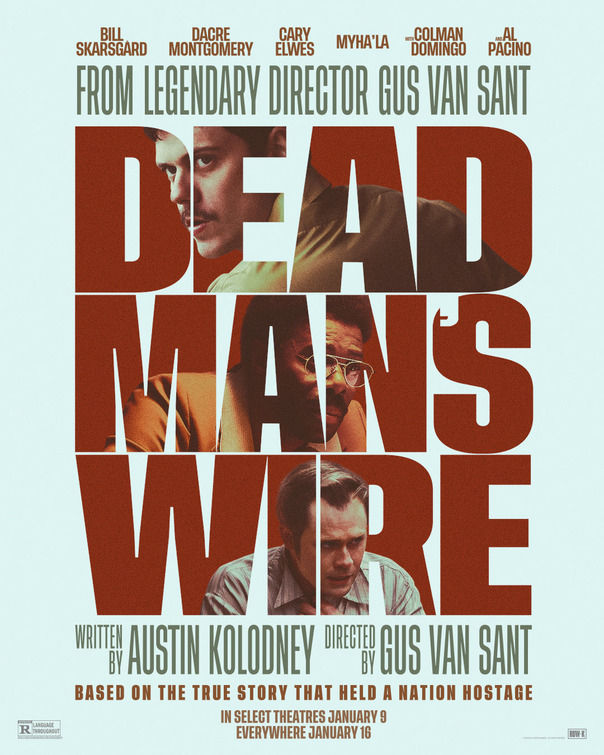
Gus Van Sant has always thrived in his observations of those of us living on the fringes of society. The freaks, the layabouts, the rejects—Van Sant’s films tend to take a long hard gaze at these characters, look away for just a moment, and then turn back to stare deeply into their very essence. Dead Man’s Wire is another dive headfirst into the peripheries, with the implied commentary every bit as eloquent as is the Van Sant Standard.
This is a meticulously researched account of the story of Tony Kiritsis, who is played by Bill Skarsgård—a casting which is certainly flattering to Kiritsis. It is clear that accuracy was of paramount importance to Van Sant and writer Austin Kolodney in this production; a priority that is exemplified by bringing on Alan Berry and Mark Enochs—a filmmaking duo who previously released a documentary on this very subject. The ensemble cast of supporting actors and actresses provided gripping contributions, with Dacre Montgomery in particular getting a chance to really flex some dramatic chops. Coleman Domingo and Robert DeNiro only had a combined three days on set, but that was more than enough for their respective larger-than-life personalities to shine through.
What is so appealing about this real world retelling of a hostage crisis in 1970s Indianapolis—and what surely drew Gus Van Sant to it—is that it doesn’t really require any embellishment. This is one of those instances where real life was every bit as wild as any fiction one could invent. That can make everything fairly straightforward, but it comes with added scrutiny. Van Sant is a raconteur who enjoys take the occasional creative liberty, so one of the most notable aspects of this film is the grounded reality that I know must have made him squirm at times.
The year is still very young, but this is the most exceptional work it has presented us with so far. A collection of creatives who all fully have a grasp on not only their own abilities, but also how those abilities can best function within the scope of this presentation. This results in a sharp narrative with very little wasted action. It is likely to be one of the most timeless movies to come out of the year, even if more ambitious films do come along.
All You Need is Kill -

One interesting thing about the experience of watching All You Need Is Kill is the distinct sense of déjà vu if you have seen the movie Edge of Tomorrow before. Rest easy this is NOT just a gender-swapped ripoff. If anything, it would be precisely the opposite. Edge of Tomorrow was an adaptation of the All You Need Is Kill light novel and manga, which came out in 2004.
This long-awaited direct interpretation of that manga to the screen brings a charm that is entirely its own. It is more of a chaotic experience than either the source material or the Crusian take on the story, but it certainly makes for a thrill ride. Plenty of people will feel that it could have benefited from a little slowing down and smelling the flowers, but there are upsides to jumping right in and hitting the ground running.
Had this been the earth-shattering concept that it first was when Hiroshi Sakurazaka first dropped it on us over two decades ago, it might have been a little more disappointing that they didn’t choose to add another half hour on the runtime and flesh out some of these core concepts a little more fully. As it is, it smashes you across the head with some of the killer visuals that have become synonymous with Studio 4°C, and takes you on the cinematic equivalent of whitewater rafting without a guide. This is a movie that may not always do a great job of telling you what it is thinking, but it always does a fantastic job of showing you what it is feeling.
~The Film Encomium~


Comments